Your Plant Is Patient Until 3 PM
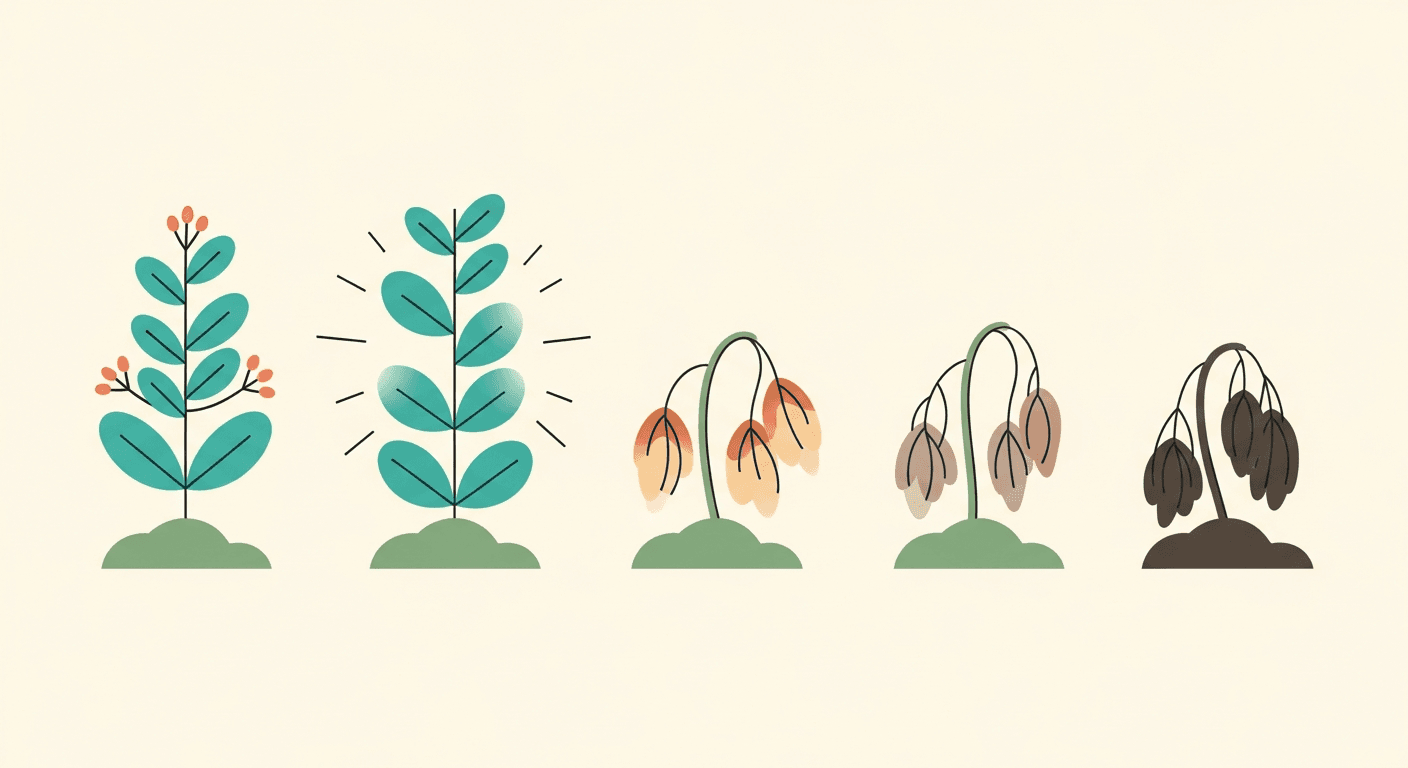
You open feeldata at 10 AM. You haven't logged anything yet. Not a single habit checked off.
And your plant? It's breathing. Calm, in rich teal, waiting for you. No reproach, no countdown, no red alert.
Because until 3 PM, your garden waits patiently.
In short: The new 5-level system replaces the old good-or-bad logic with five empathetic states. Your plant responds to consistency, not volume. A single habit maintained for 30 days will make it flourish more than five habits you check off sporadically.
Five Levels Instead of Good or Bad
Until now, the garden knew only two states: everything done or not. That binary logic created exactly the anxiety we wanted to eliminate. Research shows that punitive streak mechanics drive users to abandon apps entirely rather than continue after a break.
The new system uses five levels that feel like a weather forecast for your habits:
Thriving. All of today's habits completed. Your plant stands upright in vibrant teal. Nothing more to do.
Anticipating. The garden is patiently waiting. The plant shows a gentle breathing animation, alive and ready. This is the state in the morning before you've started, and it stays until 3 PM.
Thirsty. A quiet hint. After 3 PM, if you have habits with active streaks still incomplete, the plant tilts four degrees. The color shifts to amber. Not an alarm, just a gentle reminder.
Wilting. Yesterday was missed. The plant turns gray and tilts further. But the message stays inviting: "Your plant needs care; it will recover when you return."
Parched. Multiple days missed. This state arrives in a future version and shows an even stronger tilt with a slow pulse. Even here, your plant is never dead.
Your Morning Is Yours
The most important design decision is one you'll never notice: the garden gives you room to start slow.
Before 3 PM, your plant shows "Anticipating," regardless of whether you've completed anything. Only after that does it shift to "Thirsty," and only if you have active streaks at risk.
Why 3 PM? Most people have finished their daily routines by early afternoon. An earlier time would create unnecessary pressure. A later one would be too lenient to serve as a reminder.
This decision rests on a simple principle: if you don't have an active streak, there's nothing to protect, and nothing for the plant to worry about. It stays calm.
Fewer Habits, More Consistency
The visual design reflects something deeper.
Phillippa Lally and her team at University College London found in 2010 that a new habit takes an average of 66 days to become automatic. The range spans 18 to 254 days depending on complexity (Lally et al., 2010). A recent meta-analysis by Singh et al. (2024), evaluating 20 studies with 2,601 participants, confirms this considerable variability.
What does this mean for your garden?
A streak counts more than the number of habits. A single habit maintained for 30 days takes your plant from seed to lush bloom, coral flowers and all. Five habits that you forget on different days leave you permanently oscillating between "Thirsty" and "Wilting."
BJ Fogg, who leads the Behavior Design Lab at Stanford, calls this approach "Start Tiny": choose one behavior, make it incredibly small, find its natural place in your day, and let it grow (Fogg, 2020). Motivation fluctuates. Ability, meaning how easy something is, endures.
Start with one habit. The fastest path to a thriving garden is one habit you actually do every day. Only add a second when the first has become automatic.
Duolingo discovered something similar. In 2023, they decoupled the streak from the daily goal so that a single lesson was enough to extend it. Learners with 7+ day streaks increased by over 40 percent (Duolingo, 2024). Less punishment, more consistency.
Your Plant Grows With You
The garden has five growth stages that evolve with your consistency:
- Seed. Day 0. The beginning.
- Sprout. From day 3. First leaves appear.
- Growing. From day 7. The stem grows taller, more leaves.
- Blooming. From day 14. The first coral blossom opens.
- Lush. From day 30. Full bloom, dense foliage, multiple flowers.
One important rule: Your plant never resets to seed. If you've reached "Lush" and take a week off, you return to "Lush (Wilting)," not to the beginning. Your progress is preserved.
And recovery is fast. A single check-in after a break triggers a welcome-back animation. After that, you're right back to "Thriving."
Lally's research shows: a single missed day has no measurable effect on habit formation. Your garden reflects exactly that.
Milestones Along the Way
As your streak grows, you reach milestones that mark your progress:
- 7 days: First week done
- 21 days: Habit formed
- 30 days: One month maintained
- 66 days: Automatic (the median from Lally's study)
- 100 days: Century Club
- 365 days: A full year
Think of these as trail markers, not finish lines. They show you how far you've come.
What You Can Do Today
Open feeldata. Choose one habit. Just one. Make it small enough that you could still do it on your worst day.
Then do it again tomorrow. And the day after.
Your garden will show you.
Sources
- Lally, P., van Jaarsveld, C. H. M., Potts, H. W. W., & Wardle, J. (2010). How are habits formed: Modelling habit formation in the real world. European Journal of Social Psychology, 40(6), 998–1009. DOI: 10.1002/ejsp.674
- Singh, B., Olds, T., & Maher, C. (2024). Time to Form a Habit: A Systematic Review and Meta-Analysis of Health Behaviour Habit Formation and Its Determinants. Healthcare, 12(23), 2488. PMC11641623
- Fogg, B. J. (2020). Tiny Habits: The Small Changes That Change Everything. Houghton Mifflin Harcourt. tinyhabits.com
- Keller, J., Kwasnicka, D., Klaiber, P., Sichert, L., Lally, P., & Fleig, L. (2021). Habit formation following routine-based versus time-based cue planning. British Journal of Health Psychology, 26(3), 807–824.
- Duolingo (2024). Improving the streak: Forming habits one lesson at a time. blog.duolingo.com